
Presented by Avalon Health Economics
Novel diagnostics often face commercialization challenges unique from those associated with drugs, devices, or procedures. While a diagnostic tool itself may not directly improve outcomes, it may still alter clinical decision-making and clinical pathways, which in turn can result in secondary impacts on long-term outcomes, utilization, costs, and patient management. The economic benefit of a novel diagnostic can be particularly elusive to stakeholders like patients or payers, as an increase in diagnostic performance often leads to earlier disease identification which can trigger additional treatment expenses.
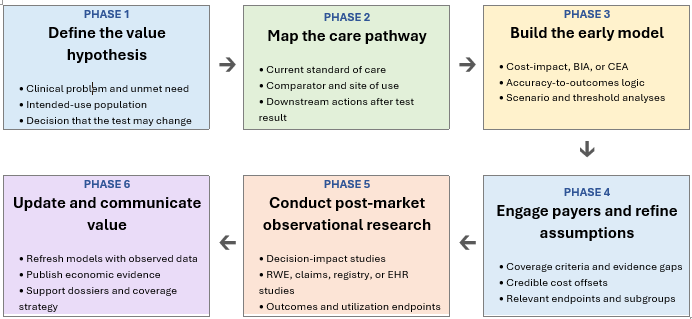
To combat the “evidence challenge” for diagnostics, a diagnostic’s economic story should reach beyond clinical performance and clinical utility to quantify the tangible changes to adoption, coverage, and payment, providing evidence essential to commercial payers. Figure 1 presents a suggested “roadmap” consisting of six essential phases of economic evidence development for diagnostics.
1. Defining the value hypothesis
Defining the value hypothesis begins with identifying the clinical problem and unmet need and then isolating the potential market. Market identification entails quantifying the disease prevalence and incidence, the prevalence of the undiagnosed population, and the portion of symptomatic patients currently being tested with a diagnostic. The value hypothesis will center around the decision that the test may change, making mapping of the care pathway the next essential step.
2. Mapping the care pathway
Downstream finances may look different for tools used for screening, for-cause diagnosis, prognosis, and post-treatment monitoring. Understanding the care pathway is a helpful way to recognize the currently used standard of care; whether this be the absence of any testing, an alternate diagnostic tool, or watchful waiting. Identification of the standard of care enables clarification of target clinical and economic performance that will be an essential comparison during product commercialization. A conceptual model can be a powerful tool when introducing the product to clinicians and payers as it directly emphasizes the intended use and clinical implications in a digestible manner.
3. Building an early model
Clinical data maturity and target audience are generally the best indicators of what to prioritize in the modeling process. A cost-impact model is often the first type of model developed for a new product, as it can be built with the least amount of data and presents the net economic offset when compared to standard care. A cost-effectiveness model steps beyond quantification of healthcare costs by also placing a monetary value on quality of life and extended life years. This can be particularly useful for diagnostics that improve survival outcomes through earlier diagnosis. A budget-impact model is the most directly utilized piece of evidence by payers when making coverage decisions. These models estimate the financial consequences of adopting a new technology for a covered population, considering market share distribution and growth, technology costs, and changes in condition-related healthcare costs.
Test accuracy, most often captured as sensitivity and specificity or positive predictive value (PPV) and negative predictive value (NPV), often acts as the bridge between clinical validity and model outcomes. A basic diagnostic model can be developed by assigning patients into groups based on test performance and disease prevalence: true positive, false positive, true negative, and false negative.
Given the distinct challenges that many novel diagnostics face in developing clinical and economic outcomes data, there is often a significant level of uncertainty present in early analyses. Sensitivity analysis is therefore an essential tool to mitigate potential skepticism due to assumption-based inputs or those based on underpowered clinical studies. Uncertainty can be further minimized by providing multiple scenario analyses to account for alternate test frequencies, populations, or comparators.
4. Engaging payers and refining assumptions
Occasionally, manufacturers develop evidence that is scientifically sound but that fails to demonstrate the potential for commercial success to potential payers. Payer research (such as interviews or questionnaires) can direct manufacturers to the outcomes, comparators, populations, and product applications that hold the most influence over coverage decisions.
5. Conducting post-market observational research
After model development, post-market evidence should be obtained to refine previously generated economic evidence. Diagnostics may generate value pathways that do not fully emerge until after product launch, when clinician behavior, medication use, patient selection, and more may be revealed. For diagnostics in particular, we recommend that developers look beyond traditional narrow clinical endpoints, with attention to pathways of value that may have been previously unrecognized. Post-market evidence should not only be used to confirm an original value story, but to expand the potential where it may not have been indicated during value story conception.
6. Updating and communicating value
The final step in the diagnostic commercialization process is a cyclic, unending process that emphasizes the fluid nature of the evidence story. Models should be constantly refreshed with newly observed clinical and economic data. Early economic models should be finalized and published in peer-reviewed journals to promote readership and encourage confidence in economic predictions. Finally, all generated evidence should be compiled into clinician- and payer-facing dossiers and coverage strategies. As new data become available, all materials should be updated to further strengthen the economic value story.
Learn more at https://avalonecon.com and be sure to attend the Solutions Showcase to hear more from the Avalon Health Economics team.